
Feeling Anxious? You're Not Alone.
If anxiety is affecting your sleep, focus, or relationships — you’re not broken. And you don’t need to rely solely on medication to feel better.
Many clients I work with find relief using simple, proven strategies that calm the nervous system, reframe intrusive thoughts, and build confidence over time.
In this blog, you’ll learn 7 powerful, natural techniques to ease anxiety — all backed by science and real-world results.

Box Breathing: Calm Your Body in 60 Seconds

Box Breathing: Calm Your Body in 60 Seconds
One of the quickest ways to regulate anxiety is through your breath.
Box Breathing is a powerful, simple technique used by Navy SEALs, athletes, and therapists alike.
Box Breathing Technique:
🟦 Inhale for 4 seconds
🟦 Hold for 4 seconds
🟦 Exhale for 4 seconds
🟦 Hold for 4 seconds
Repeat for 1–3 minutes.
This reduces cortisol, lowers your heart rate, and brings clarity to spiralling thoughts.
It creates space between stimulus and reaction—so you can choose your response.
Use it before stressful meetings, when panic rises, or to prepare for restful sleep.
Over time, this builds emotional resilience and nervous system flexibility.
The more you practise, the easier it becomes to stay calm under pressure.
Breathe. Pause. Regain control—one box at a time.

Progressive Muscle Relaxation (PMR): Release the Tension
Anxiety often shows up physically: clenched jaws, tight shoulders, restlessness.
Progressive Muscle Relaxation helps you tune into your body and let go of hidden stress.
How to Do It:
Start from your toes and work upward — tense each muscle group for 5 seconds, then release.
Notice the contrast between tension and relaxation.
Breathe deeply as you move through each area: feet, calves, thighs, stomach, hands, arms, neck, and face.
👉 Even 10 minutes a day helps break the fight-or-flight loop.
It teaches your body to recognise and reverse stress patterns.
Over time, this reduces physical symptoms of anxiety and improves sleep quality.
PMR can also sharpen your awareness of emotional triggers.
You can practise lying down, seated, or even discreetly at your desk.
Feel the tension melt away—and with it, the mental weight you didn’t realise you were carrying.

Self-Hypnosis: Tap Into Subconscious Calm
Self-hypnosis trains your mind to shift from panic to peace — even if your environment is chaotic.
It creates a powerful bridge between your conscious awareness and deeper inner calm.
By practising regularly, you strengthen your ability to self-soothe and stay grounded.
Try This:
💡 Find a quiet space, close your eyes, and breathe deeply.
Visualise a calm place — a beach, a forest, or a safe memory — and repeat a positive affirmation:
“I am safe. I am in control. This will pass.”
Stay in this state for 5–10 minutes, allowing your body and mind to soften.
Even short sessions can train your brain to recover faster from stress.
The more you practise, the more automatic calm becomes in daily life.
Self-hypnosis is a skill — and like any skill, it gets stronger with repetition.
🌀 Want guided support? Learn more about

Grounding Techniques: Anchor Into the Present Moment
When your thoughts spiral, grounding pulls you back to the here and now.
5-4-3-2-1 Method:
5 things you can see
4 things you can touch
3 things you can hear
2 things you can smell
1 thing you can taste
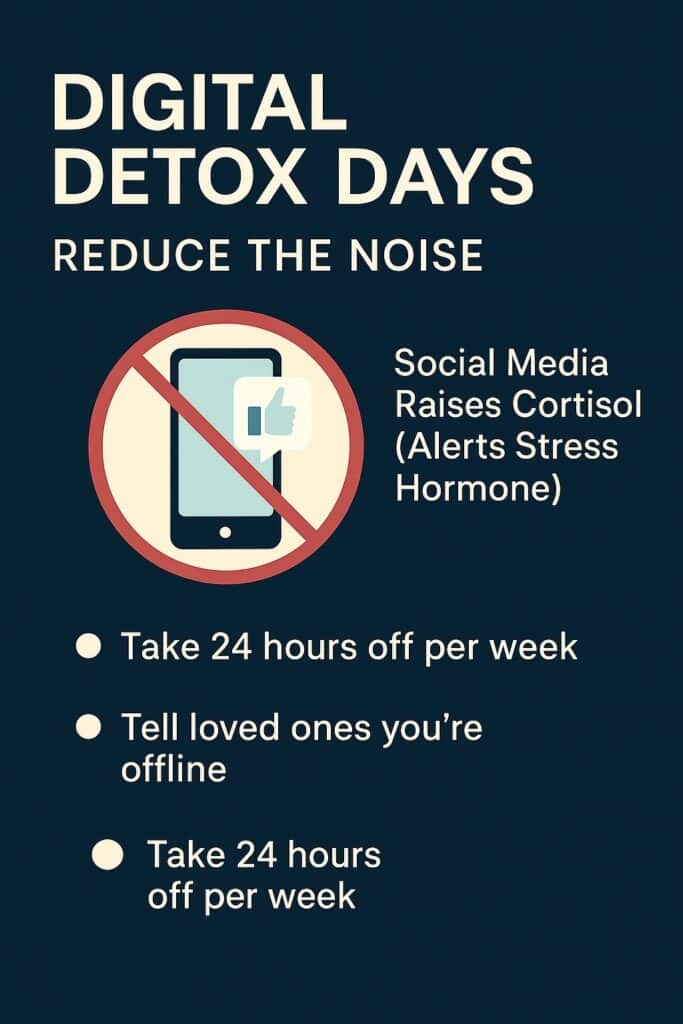
Digital Detox Days: Reduce the Noise
Social media can trigger comparison, overstimulation, and constant alertness — all of which fuel anxiety.
Endless scrolling trains your brain to crave dopamine hits and stay on high alert.
A digital detox helps reset your nervous system and reclaim your focus.
Try This:
📵 Set aside one day per week without social apps.
🌿 Replace it with a walk, journaling, or creative time.
Connect with your surroundings, not your screen.
You’ll be amazed at the clarity that returns.
Even short breaks improve sleep, mood, and productivity.
Your mind becomes quieter, your thoughts more your own.
You’ll notice how often you reach for your phone — and why.
This isn’t about restriction. It’s about freedom.
Less noise. More presence. Real peace.

Guided Journaling: Get the Thoughts Out of Your Head
Writing helps process emotions and break ruminative cycles.
When you journal, you give your inner voice a safe, structured place to be heard.
It clears mental clutter, reveals patterns, and brings perspective to anxious thinking.
Prompt Ideas:
📝 What’s the anxious thought?
📝 What triggered it?
📝 What’s one small win from today?
You don’t need perfect grammar — just honesty.
Journaling shifts the experience from in you to in front of you.
This distance allows for clarity, compassion, and choice.
Over time, you’ll notice recurring themes and deeper truths.
Try setting a 10-minute timer to free-write each day.
Your journal becomes a mirror — and a map.

Talk to a Specialist — You’re Not Alone
You don’t have to figure this out by yourself.
Whether you’re dealing with generalised anxiety, panic attacks, or social phobia — there are personalised approaches that work.
🔗 NHS – Generalised Anxiety Disorder (GAD)
Or explore tailored hypnotherapy for anxiety with me.
Why Talk to a Specialist?
✔️ Confidential & non-judgemental space
✔️ Tools to manage anxiety, depression, addiction, and more
✔️ Support tailored to your unique story
✔️ Fast-track emotional healing & personal growth
🌱 Real Support, Real Change
Talking helps. Studies show that:
🧘 80% feel calmer after just one session
💪 70% report long-term improvement
⏳ Early support reduces crisis risk by 50%
Take One Step Today
You don’t need to master all 7 techniques. Start with just one:
🟢 One breathwork session
🟢 One journal entry
🟢 One screen-free afternoon
🟢 One calming audio
That’s how healing begins.
Ready for Personalised Support?
I offer tailored anxiety hypnotherapy sessions online and in-person in Wokingham. My approach is grounded, empathetic, and built on results.
Many of my clients say:
“I’ve tried everything — and this finally worked.”
🎯 Ready to try something different?
📞 Book Your Free Consultation
📲 Or text/WhatsApp me directly: 07562 745 578
Let’s help you feel calm, capable, and in control again.